The Chessboard is made up of 64 squares, in a pattern of 8 x 8, alternating black and white, or dark and light, in color. When playing a game, the board must always be turned so there's a light square in the lower right hand corner. The saying "Light on Right" will help you remember this.
The vertical columns on the chessboard are called "files". You might remember this by thinking about a vertical "file" cabinet. Note that each file is called by a letter.
The rows on the chessboard are called "ranks". You can remember this is by noting that both "row" and "rank" start with the letter R. Note that each rank is called by a number.
Each square on the board has a name arrived at by putting together its file position and its rank position.
A series of squares going from corner to corner is called a diagonal. Diagonals are identified by their beginning and ending squares.

Chess is a game of war between the black army at the top of the board, and the white army at the bottom of the board. Although we always call the two sides Black and White, chess sets can vary quite a lot in color. The darker pieces are always referred to as Black and the lighter pieces are always referred to as White.
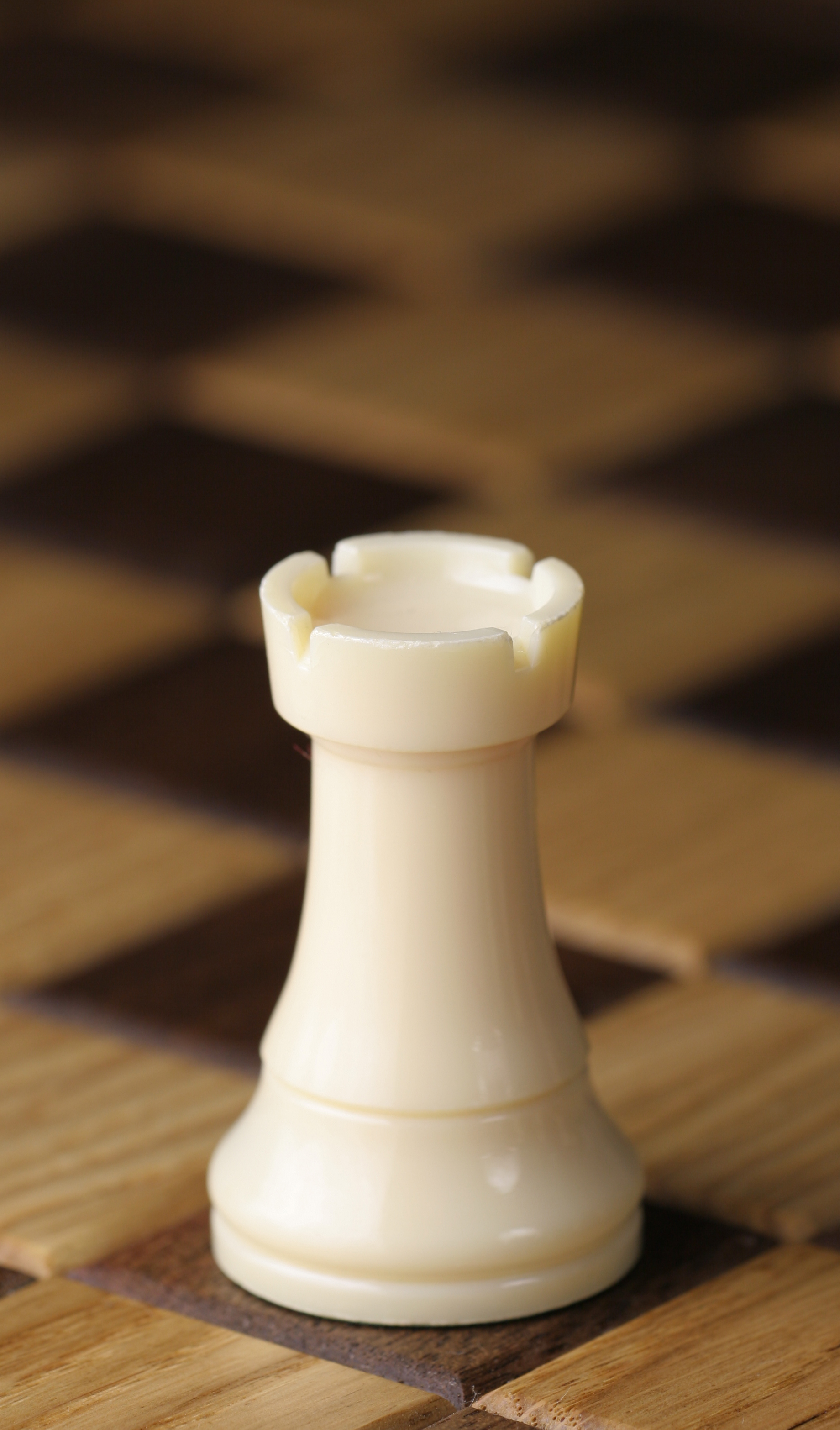
Standing solidly at the four corners of the board are the Rooks, looking like the castle towers they represent.
Next to each Rook, galloping into the castle, are the four Knights, which usually resemble horses.
In the center stand the King and his Queen. Note that the White Queen always starts the game on a light square and the black Queen always starts on a dark square.
The left and right sides of the board are named for the starting positions of the King and Queen.
Next to the King and Queen go their trusted advisers, the Bishops.
And finally, in front of each of these pieces, stand the Pawns, the foot soldiers of the army.
The player with the White pieces always moves first in a game of Chess. Each player moves one piece per turn.
Kings can vary quite a bit in appearance from chess set to chess set, but in general, the King can be identified by the fact that it's the tallest piece. In many chess sets, the King also has a cross on top.
The King is the most important piece in your army. If you allow your King to be checkmated, you have lost the game. Checkmate means that your opponent can capture your King on the next move and there's nothing you can do about it. On the other hand, if you checkmate your opponent's King, you have won the game!
The King is a powerful figure, but not a fast-moving one. From any square he occupies, he can move only one square in any direction.
Neither the King, nor any of your other pieces can move to a square occupied by another one of your own pieces.
When one of your opponent's pieces lies in the path of your King, you may not jump over it, but you can capture it. The King can only capture an opponent's piece occupying a square next to him, and he cannot capture a piece if doing so puts him into check.
In most games, the King observes from the back lines. The rest of your pieces fight the battle and protect the King until near the end of the game. Then the King usually moves out to join the fight.
Protecting your King from attack is how you keep from losing the game Because it's so important, there's a special move, called Castling, which you can use to put your King in a safe place. Castling is the only time in which you are allowed to move two of your pieces, a King and a Rook, in one move.
You can Castle either to the Kingside, which is called Castling Short, or to the Queenside, which is referred to as Castling Long.
To Castle Kingside, first move the King two spaces toward the Rook, to g1, then move the Rook to the other side of the King, on f1.
To Castle Queenside, do the same thing. Move the King two spaces toward the Rook, to c1, and move the Rook to the other side of the King, on d1.
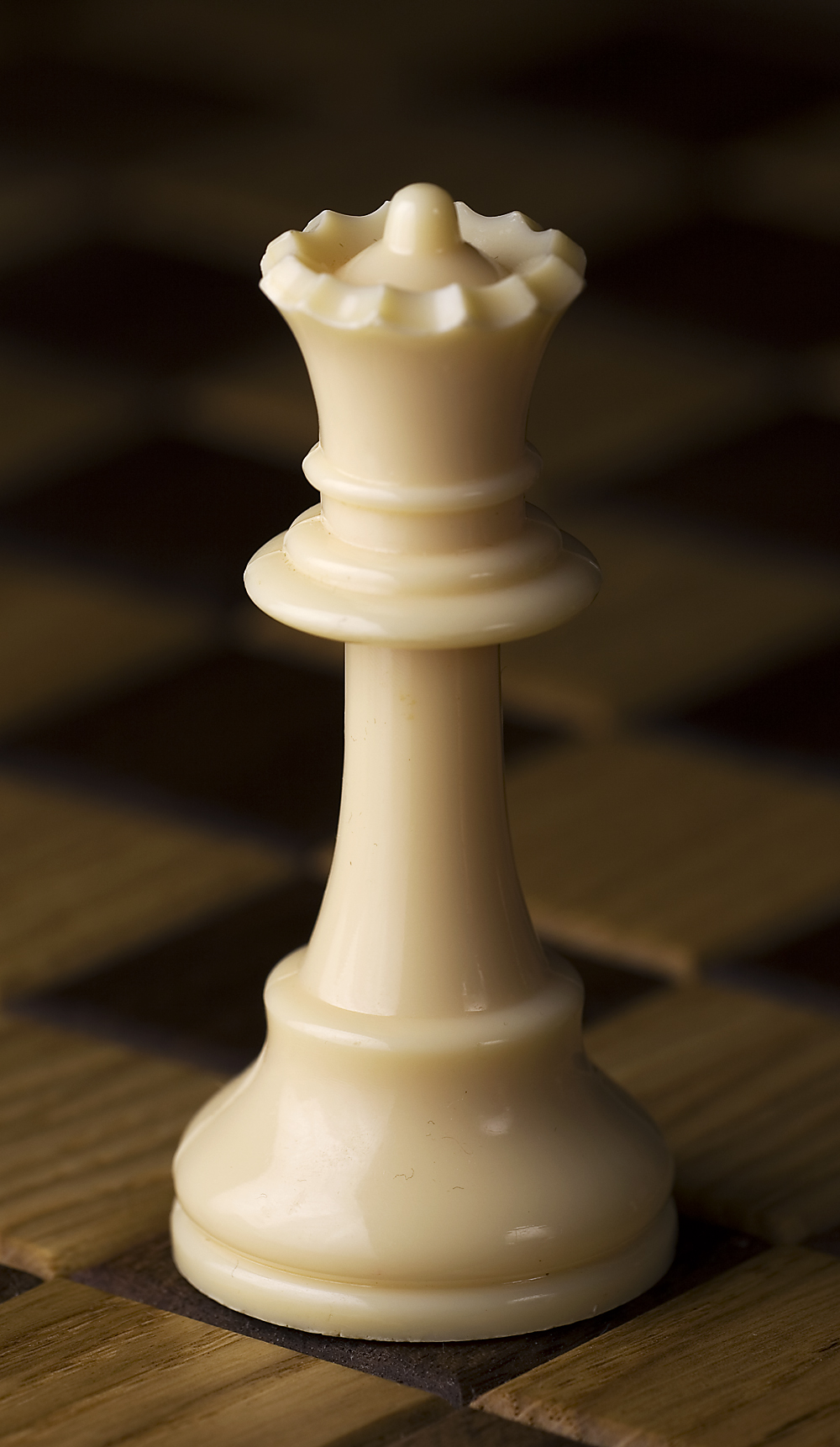
Queens can vary quite a lot in appearance from chess set to chess set, but she's usually the second in height next to the King, and is also easy to find because there's only one Queen of each color per set.
The Queen is the most powerful piece in your army. She combines the movements of both the Rook and the Bishop. Like a Rook, she can travel vertically along files or horizontally along ranks, and, like a Bishop, she can also travel diagonally.
When one of your opponent's pieces lies in the path of your Queen, you may not jump over it, but you can capture it. When your Queen captures a piece, it moves to the square the piece was on.
In a game, a wise player is careful not to bring the Queen out too early.
Rooks are easily identified in a chess set by the fact that they usually resemble the tower of a castle.
In a chess game, the Rook moves horizontally along ranks, or vertically along files.
The Rook is considered to be a strong piece because of its ability to travel long distances and attack multiple squares simultaneously.
In a game, the Rook is at its best when there are open files.
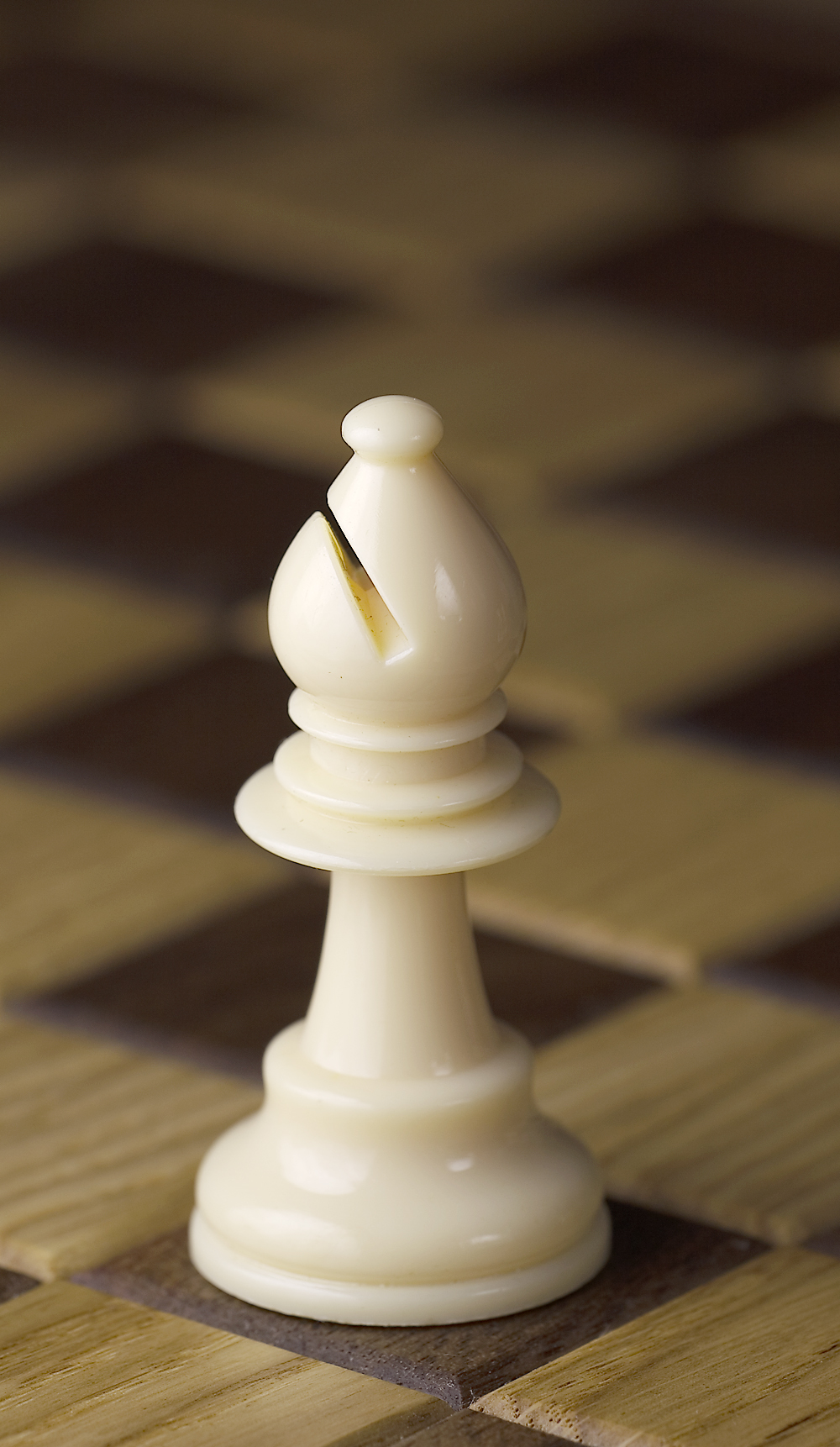
Bishops can usually be identified in a Staunton-type chess set by the notch in the hat, or top of the piece. The Bishop is often the third tallest of the pieces, next to the King and Queen and can also be identified by the fact that there are two Bishops of each color in a chess set.
In a chess game, the Bishop always moves diagonally.
Note that, at the beginning of the game, both sides have one Bishop on a light square, and one Bishop on a dark square. Because they are limited to diagonal movement, the light-squared Bishops will always remain on light squares, and the dark-squared Bishops will always remain on dark squares.
The Bishop is considered to be only a moderately strong piece because of the fact that its movement is always limited to only half the board, that is, to only the light squares, or to only the dark squares.
The strength of a Bishop in the game is that it can often sneak behind enemy lines.
Knights are easily identified in a chess set by the fact that they usually look like a horse.
In a chess game, the Knight has a special L-shaped way of moving: it always moves two squares in one direction, then one square to the left or right.
Some people find the Knight's movement easier to remember if they think of it as one straight, then one diagonal.
The Knight has another special characteristic. It's the only piece that can jump over other pieces, both its own and its opponent's
In a game, the Knight does its best work in the center of the board where it can attack the most squares. There's a term, "a Knight on the rim is grim," because a Knight along the edge attacks only four squares.
The Knight is considered to be less powerful than a Queen or a Rook because of the few squares it attacks. Even though it attacks fewer squares than a Bishop, its jumping ability still makes it a valuable piece.
Pawns are easily identified in a chess set by the fact that they are usually smaller than the chess pieces and by the fact that there are 8 pawns of each color.
In a chess game Pawns move one square at a time, always forward - never backwards or sideways.
On the Pawn's first move of the game, and only the first move, each Pawn has the option of moving two squares forward.
Only pawns have a different way of capturing than moving. To capture, Pawns always move one square diagonally
Pawns are the weakest member of the chess army because of their limitations in movement. However, when the pawns work together, they are an important part of your army. Pawns are very important to the game strategically, and sometimes, a single Pawn can make the difference between winning and losing.
You can Castle either to the Kingside, which is called Castling Short, or to the Queenside, which is referred to as Castling Long.
To Castle Kingside, first move the King two spaces toward the Rook, to g1, then move the Rook to the other side of the King, on f1.
To Castle Queenside, do the same thing. Move the King two spaces toward the Rook, to c1, and move the Rook to the other side of the King, on d1.
The King and Rook may not have moved from their starting squares.
All of the spaces between the Rook and the King must be unoccupied.
The King cannot be in Check
The squares that the King passes over cannot be under attack, and since you can never move your King into Check, the square to which it's moving can't be under attack either
En Passant is a special type of capture move for Pawns only. The term "En Passant" is French for "in passing." In Chess, it means capturing one of your opponent's Pawns if he sneaks it past yours by moving two squares.
You can only capture En Passant if your opponent moved his Pawn two squares forward; and
You MUST do the En Passant capture on your VERY next move.
When a Pawn reaches the opposite side of the board it can be PROMOTED to any piece except a King.
Normally, chess players choose to promote the Pawn to a Queen, because that's the most powerful of all chess pieces. Theoretically, if all of your Pawns made it to the other side of the board without being captured, you could actually have a total of 9 Queens on your side!
However, in some situations, a player may choose to Promote his Pawn to a piece other than a Queen. This is called UNDERPROMOTION
Remember, only Pawns can be promoted. This makes Pawns more valuable than they seem at first glance. A promotion can instantly change the balance of power in a game.
In relation to a Pawn, the Knight is worth 3 points, the Bishop is worth 3 points, the Rook is worth 5 points, and the Queen is worth 9 points. No value is assigned to the King because if you're about to lose your King, you've lost the game. Try to memorize these values as they will be very useful to you throughout your Chess career.
Based on these values, if you allow your Queen to be exchanged for one of your opponent's Pawns, you're losing 8 points in the exchange. This is called a LOSS OF MATERIAL.
You may be curious about the fact that the Bishop and Knight are valued the same. Both pieces have strengths and weaknesses, but many Chess players have come to believe that a Bishop is slightly more valuable than a Knight, though not as valuable as a Rook. Using both Bishops together, so that both light and dark squares are covered, can be a powerful combination.
Material superiority can often determine the winner of a Chess game. Piece value is something you should keep in mind when you consider your moves.
for those of you looking to learn more about chess, please take a look at the link below.